Digital Business Cards: The Complete 2026 Guide

Rebecca Vega
April 20, 2026
10 min read
In this article
If you still hand out paper business cards, you are not alone. But every conference, open house, and networking event has that one person who taps their phone to yours and walks away knowing you remembered everything. That person has a digital business card, and the gap between your follow-up rate and theirs is not a coincidence.
This guide covers what digital business cards actually are, how the technology works, what separates a good one from a bad one, and how to pick the right setup for your workflow.
---
What Is a Digital Business Card?
A digital business card is a contact-sharing tool that lives on a device or physical card rather than on a piece of paper. When you share it, the recipient gets a webpage or contact file with your name, title, phone number, email, social profiles, and anything else you want to include.
The key difference from paper: a digital card is live. Update your job title, swap your phone number, add a new LinkedIn profile, and every card you have ever shared reflects that change instantly. No reprint. No toss-pile.
Most digital business cards share via one of three methods: NFC tap, QR code, or a shareable link. Each method has a different friction profile, and the right one depends on how you network.
---
How Digital Business Cards Work
NFC (Near Field Communication)
NFC is the same chip technology behind contactless payments. A small antenna embedded in a card or phone case sends a signal to any NFC-capable phone held within a few centimeters. The recipient's phone picks it up, opens a browser tab with your profile, and the exchange is done in under two seconds, with no app required on either side.
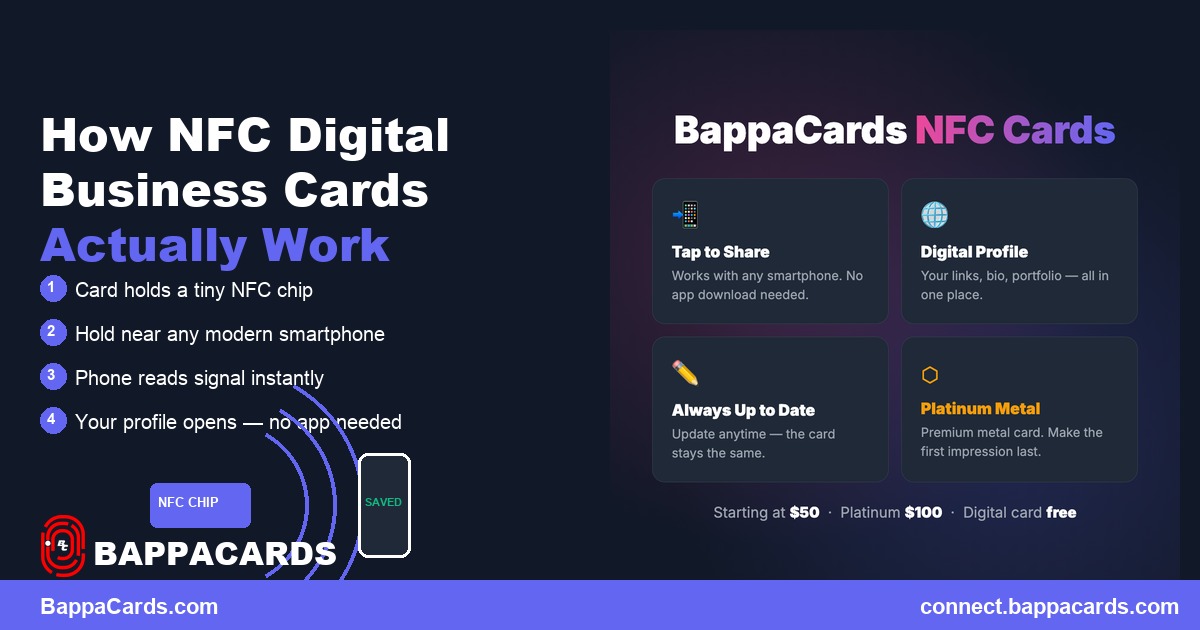
iPhones have supported NFC since the iPhone 7. Android support goes back even further. In 2026, if someone has a smartphone, NFC almost certainly works on it.
The experience is fast enough that you can tap someone's phone mid-conversation without breaking flow. That is what makes NFC the highest-converting share method. Read more about how NFC business card technology works.
QR Code
QR-based digital cards display a scannable code from your phone screen or on a printed card. The recipient opens their camera, points it at the code, and taps the notification to open your profile.
It is more steps than NFC but still better than paper. QR codes work everywhere NFC does not, including distance sharing at speaking events or displaying on a monitor at a trade show booth. See how NFC and QR codes compare for a full breakdown of when each method wins.
Shareable Link
A link-based card is exactly what it sounds like: a URL you send via text, email, or DM. The recipient taps it and sees your profile. No hardware required on your side.
Links are useful for remote outreach, email signatures, and LinkedIn bios. A strong digital card platform gives you all three methods on the same card so you can adapt to any situation.
---
Digital vs. Paper Business Cards
Let us look at what you are actually choosing between.
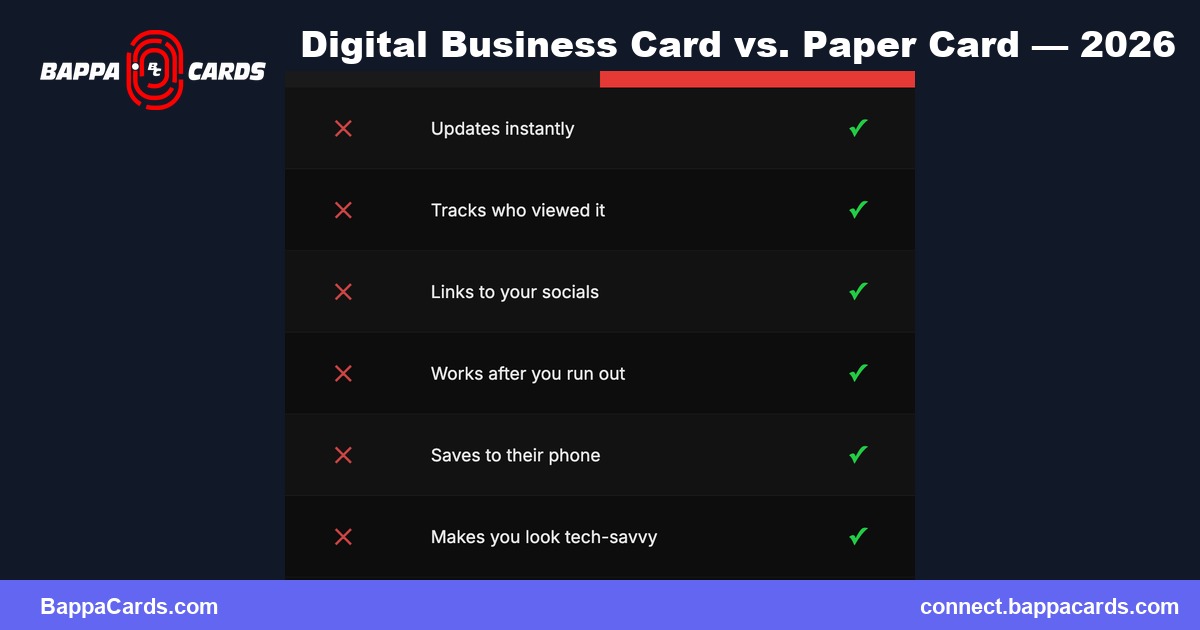
Paper cards cost roughly $25 to $50 per 250 cards. Industry surveys consistently find that 72% are thrown away within a week. The ones that survive usually live in a drawer or a stack the recipient never revisits. There is no way to update a paper card once it is printed, no way to know if anyone followed up on it, and no way to make it do anything more than sit there.
Digital cards flip that calculus:
- Update once, change everywhere. New phone number, new employer, new headshot: change it in your profile and every card you have ever shared reflects the update instantly.
- Analytics. You can see who viewed your profile, which links they clicked, and when. If you share a card at an event and someone views your profile three times over the next 48 hours, that is a warm signal worth acting on.
- No supply problem. You cannot run out. You cannot forget them at the hotel. You cannot hand out 250 and need to wait two weeks for a reprint.
- Better recipient experience. The person who receives your digital card gets a clickable profile. They can call you, email you, connect on LinkedIn, and save your contact to their phone in one tap, no manual data entry.
The full comparison of NFC vs. paper cards has the cost-per-connection math if you want to run it yourself.
---
Types of Digital Business Cards
Not all digital cards are built the same way. Here is the landscape.
App-Based Cards
Some platforms require both you and the recipient to install an app. The sharing experience is smooth when it works, but you immediately lose any contact who is not willing to download something on the spot. For B2B networking, that friction kills conversions. The whole point of sharing a card is lowering the barrier, not raising it.
NFC Physical Cards
A physical NFC card looks like a standard business card but has a chip embedded inside. You tap it to a phone and it opens your digital profile. No app required for either party.
This is the category where BappaCards sits. The physical card is a real object with weight and texture, which matters psychologically. Handing someone a metal card with your name on it reads differently than handing them a piece of cardstock. But the card itself just triggers a URL. The real value is the live digital profile behind it.
BappaCards physical cards start at $70 and come in several formats. The digital profile is free and works via link and QR code even if you do not have the physical card yet.
QR-Only Cards
Some platforms skip NFC entirely and generate a QR code for you to display or print. Lower cost, wider compatibility, but you lose the tap-share workflow that makes NFC feel effortless in person.
---
What to Look for in a Digital Business Card
If you are evaluating platforms, these are the features that actually matter.
One-Tap Sharing with No App Requirement
The recipient experience has to be zero-friction. If they need to download anything, open any app, or click through more than two screens to see your contact info, you are losing a percentage of every handoff. NFC tap to live profile is the gold standard.
Analytics You Can Act On
View counts are a start. Click tracking on individual links (LinkedIn, phone, email) is better. The best platforms show you enough to identify who is warm and worth following up with immediately.
Customization That Reflects Your Brand
Your card is a first impression. Profile photo, color palette, layout, which links appear and in what order: all of it shapes how you come across. A card that looks like everyone else's is a missed opportunity.
Easy Contact Save
After someone views your profile, the next action you want is for them to save your number to their contacts. Look for a one-tap "Save to Contacts" or vCard download on the profile. The easier that step, the higher your contact retention.
Compatibility
The card should work on any phone without requiring the recipient to do anything special. Modern NFC works on all major smartphones. QR code fallback handles older devices. A shareable link handles remote situations.
---
BappaCards: Digital Business Cards for Serious Networkers
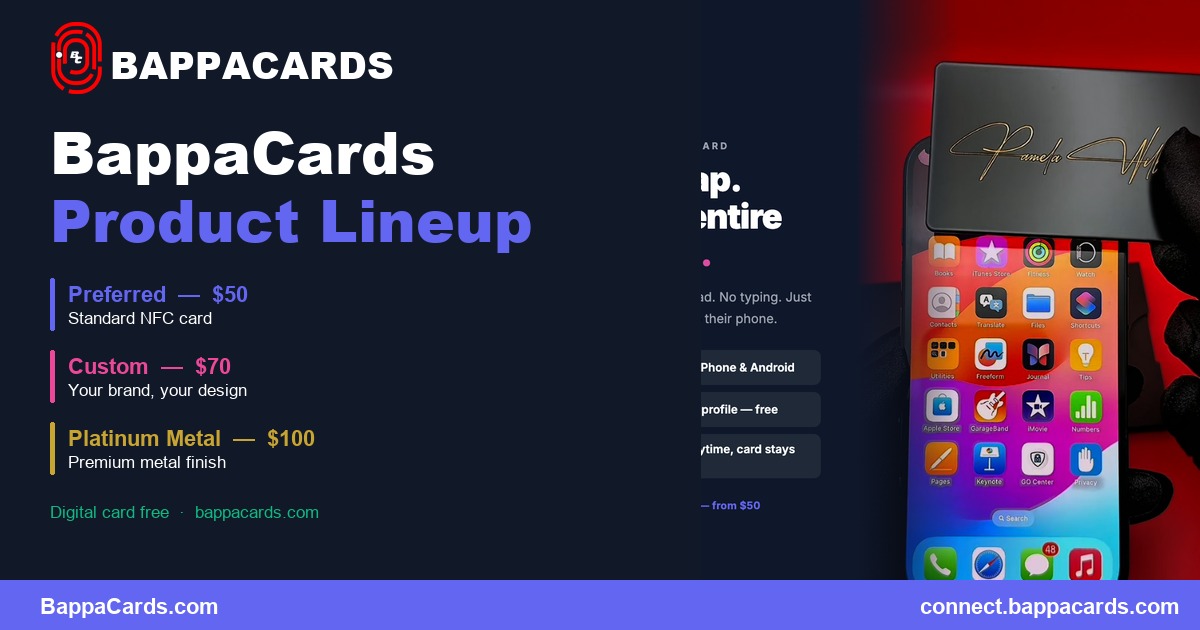
BappaCards offers NFC physical cards starting at $70 plus a free digital profile that works via link and QR from day one.
The digital profile is live and editable. You control which links appear, in what order, and with what labels. The NFC chip in the card points to your profile URL, so updating your profile updates what every card delivers without touching the card itself.
Where BappaCards distinguishes itself from cheaper alternatives is the integration with Bappa Connect. Most NFC card platforms stop at the card. BappaCards treats the card as an entry point to a full relationship management workflow.
---
Going Deeper: Bappa Connect
The card gets someone's attention. What happens after that is what turns a tap into a deal.
Bappa Connect is a personal relationship management platform built on top of your contact list. When you add someone to Connect, it researches them in roughly 90 seconds: LinkedIn profile, company context, recent activity, social data, anything publicly available that helps you understand who they are and whether they are worth prioritizing.
That research feeds a compatibility score (0 to 100) that ranks your contacts against your stated goals. If you are trying to get introductions to Atlanta-based sales managers, Connect surfaces the people in your network who are closest to that description, even if you have never thought of them that way.
It also generates personalized outreach based on what it learns. Not templates. Context-aware messages that reference what the person actually does, what they care about, and how they connect to your goals.
Bappa Connect is free with every Bappa card. No upgrade, no activation. The free plan covers 10 contacts and 10 AI research runs a month; Premium Plus ($12/month) raises that to 2,500 contacts and 600 research runs and adds Google Calendar, GoHighLevel, and Salesforce sync. It is available now at connect.bappacards.com.
The combination of a BappaCard and Bappa Connect means you are not just exchanging contact info. You are building an intelligence layer around your network that tells you who to reach out to, when, and with what angle. That is a meaningfully different category than a digital business card that just replaces paper.
Bappa Teams, which brings centralized card management and analytics to organizations, is available today. Contact us and we'll get your group set up.
---
Who Benefits Most from Digital Business Cards
Digital cards help anyone who networks regularly, but a few groups see outsized returns.
Sales Professionals
In sales, the first impression and the follow-up are everything. A digital card with tap-and-go sharing makes the introduction smoother. Analytics on who viewed your profile after an event help you prioritize follow-up calls. Connect's outreach layer helps you personalize those calls faster than researching each person manually.
Real Estate Agents
Open houses are one of the highest-volume contact exchange situations in any industry. An agent hosting an open house might shake hands with 30 people in two hours. Paper cards work, but they end up in bags and get forgotten. An NFC card tap goes directly to a live profile the buyer can reference later. See the full playbook in our digital business cards for real estate agents guide.
Recruiters
Recruiters meet candidates and hiring managers constantly: career fairs, networking events, LinkedIn meetups. A digital card that includes links to your agency's job board and your LinkedIn profile gives candidates a frictionless way to follow up.
Founders and Executives
For founders, every conversation is a potential investor, partner, customer, or hire. The card reflects the brand. A metal BappaCard taps differently than a paper card, and the digital profile can link to your pitch deck, company site, or calendar booking page in whatever order makes sense for the conversation.
Conference Attendees
The conference networking guide covers the full playbook, but the short version: at conferences, you meet too many people to follow up with all of them manually. A digital card with view analytics tells you who followed up on their end first. Those are your warmest leads.
---
How to Switch to a Digital Business Card
If you have never set up a digital card before, here is how straightforward it is.
- Create your profile. Go to bappacards.com and fill in your name, title, photo, and links. This takes about 10 minutes.
- Get your link. Your profile URL is shareable immediately via text, email, or LinkedIn bio. No physical card required to start.
- Add your physical card when ready. Cards start at $70 and ship pre-programmed to your profile. Tap it to any NFC phone to verify it works.
- Connect your workflow. If you want the relationship intelligence layer, set up Bappa Connect and start adding the contacts you want to prioritize.
You do not need to throw away your paper cards on day one. Most people keep a few paper cards for situations where someone specifically asks for one, then stop reordering once the stack runs out.
---
FAQ
Are digital business cards actually useful or is it just a novelty?
Useful, with some caveats. The NFC tap is faster than paper in practice. The analytics are real and actionable. The update-once feature saves reprinting costs over time. Whether you use the relationship intelligence layer determines whether the card is just a cooler paper card or a meaningful workflow change. The card alone is a better paper card. The card plus Connect is a different category of tool.
Do I need an NFC-enabled phone to use a digital business card?
You need an NFC-enabled phone to tap someone else's card. Both modern iPhones (iPhone 7 and later) and most Android phones support NFC. The recipient of your card does not need to do anything special, NFC is passive and works automatically when a phone is near the card.
What happens if my phone runs out of battery?
Your physical NFC card works independently of your phone battery. The card has its own chip. Tapping it to someone's phone opens your profile with no connection to your phone's charge state. If you are sharing via QR code from your phone screen, that does require battery.
Can I update my digital business card after I order it?
Yes. The physical card points to your profile URL. Update your profile and the card automatically reflects the changes. You never need to reorder.
How much does a BappaCard cost?
Physical cards start at $70. The digital profile is free and usable via link and QR code immediately after signup. Bappa Connect is free with every card, with 10 contacts and 10 AI research runs a month on the free plan. Premium Plus ($12/month) raises those limits to 2,500 contacts and 600 research runs.
Is Bappa Connect a CRM?
Not exactly. It is closer to a relationship intelligence layer. Traditional CRMs store contact data and activity logs. Connect researches your contacts, scores them against your goals, and generates personalized outreach. It integrates with your existing workflow rather than replacing it.
How is this different from just using LinkedIn?
LinkedIn is a discovery platform. You find people, connect, send messages. Bappa Connect sits on top of the contacts you already have (from the card, from LinkedIn, from anywhere) and tells you who to talk to and what to say based on what you are trying to accomplish. They are complementary tools, not substitutes.
Is Bappa Teams available now?
Bappa Teams is available today. Contact us and we'll get your group set up.
---
Wrapping Up
Digital business cards have crossed the threshold from novelty to practical tool. NFC tap sharing is fast enough that it does not slow down a conversation. Analytics give you visibility into follow-up that paper cards will never provide. And for people who network seriously, the combination of a card and a relationship intelligence layer like Bappa Connect turns contact exchange into a repeatable, measurable process.
If you are still running paper cards because you have not found the time to switch, the setup really does take about 10 minutes. Start with the free profile, see how the link works, and order the physical card when you are convinced.
---
Related reading:
- What Is an NFC Business Card?
- NFC vs. QR Code Business Cards
- NFC Business Cards vs. Paper
- The 5 Best NFC Business Cards in 2026
- How to Network at Conferences
Rebecca Vega
Senior BDR at Bappa Cards
Rebecca helps professionals and teams adopt digital networking tools that create real business results. She writes about NFC technology, digital business cards, and practical networking strategies.
Ready to network smarter?
BappaCards gives you NFC business cards, AI contact research, and relationship tools in one subscription.
See Plans and PricingRelated Articles
Ready to go digital?
Create your free BappaCards profile and start making stronger connections today.
Get Started Free